

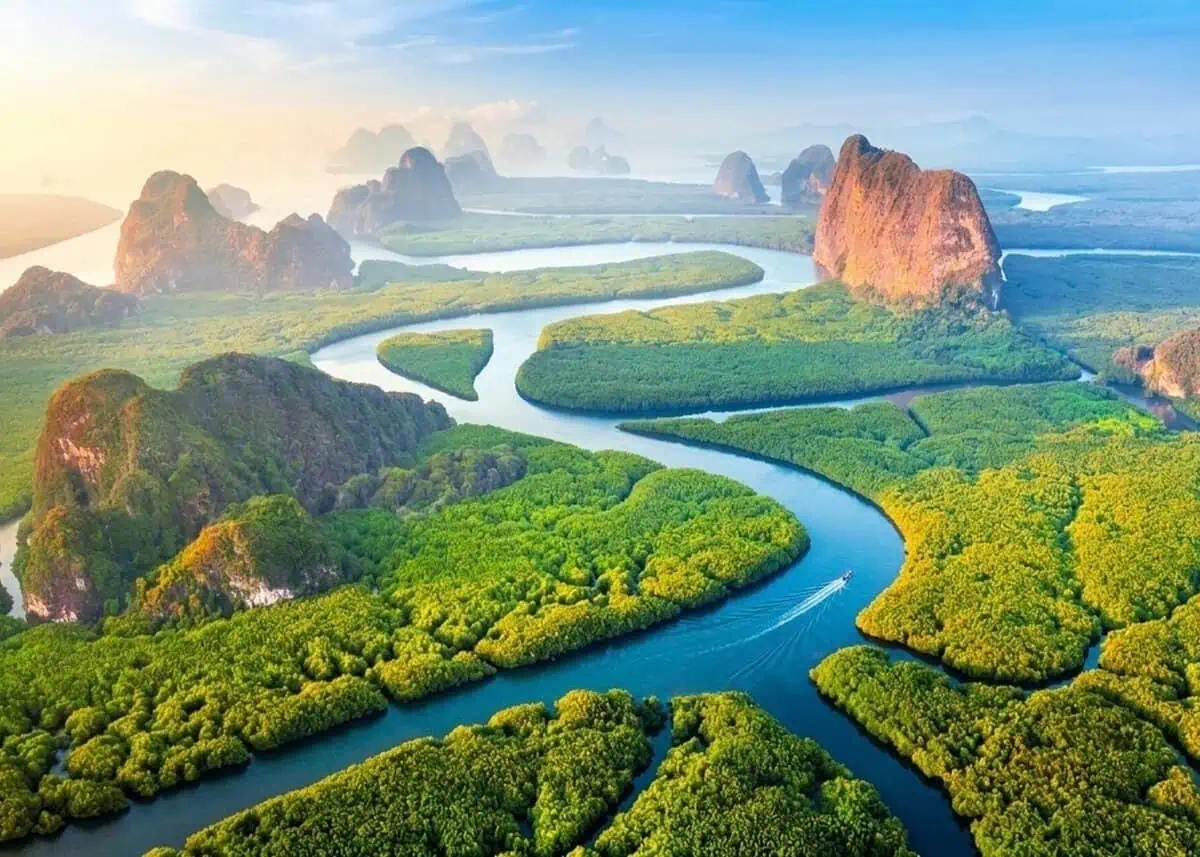
Limestone needles rising from emerald water, hidden lagoons you can only reach by kayak, a whole village floating on stilts and mangrove forests that breathe with the tide. I have been guiding boats into this bay for over twenty years, and it still gives me goosebumps. Here is everything I tell my guests before we cast off – the honest version.
| Location | 25 km north-east of Phuket, between Phuket and Krabi |
|---|---|
| Size | 400 km² with 42 islands, Ao Phang Nga National Park (1981), Ramsar site (2012) |
| Travel time from Phuket | 45–90 min by boat after 30–60 min hotel transfer |
| Tour prices | 2,300–4,500 THB (group), more for private charters |
| Tour duration | 8–10 hours including transfers |
| Best time to visit | Year-round (sheltered bay); November–April is ideal |
| Main attractions | James Bond Island, Koh Panyee, hongs, sea cave kayaking, Suwankuha Temple |
| Famous for | The Man with the Golden Gun (1974), hidden lagoons |
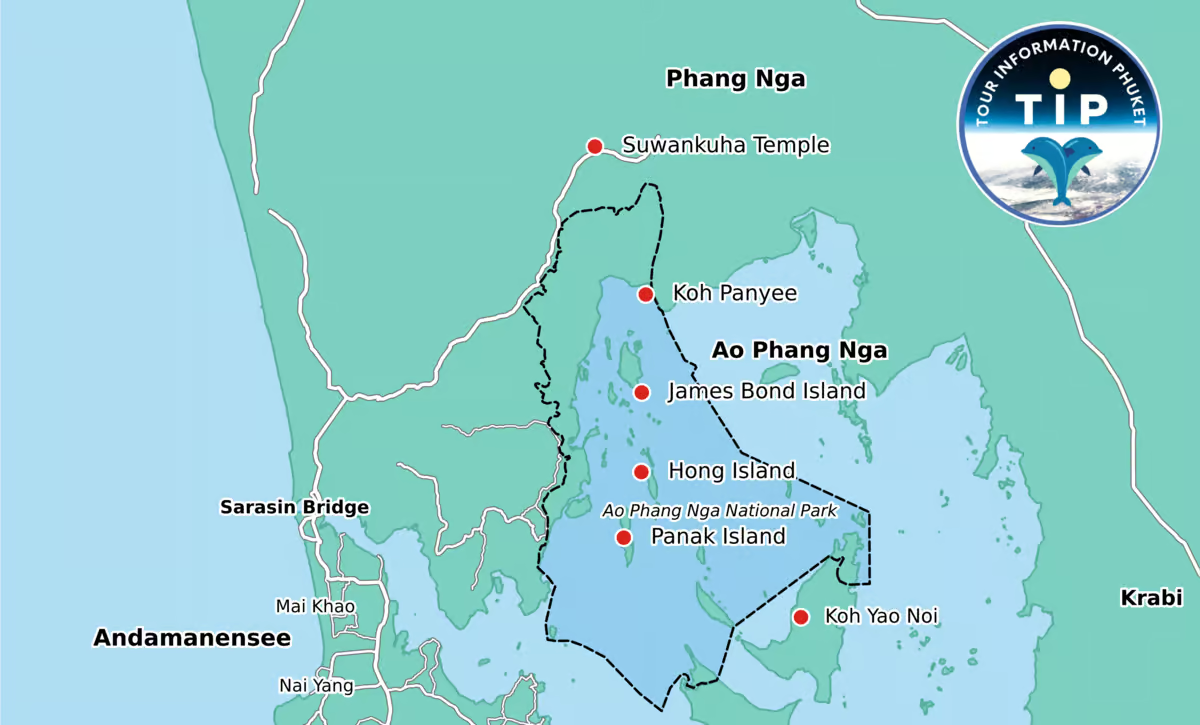
It became a national park in 1981 and a Ramsar wetland of international importance in 2012. That protection is not just paperwork: it is the reason the mangroves, the coral patches and the wildlife are still here, decades after tourism arrived. When I first ran boats here in the early 2000s, the rules were looser and the crowds smaller. The bay has changed – mostly for the better – and I would not trade the experience for anything.
One honest piece of advice before you book: take a tour that starts early. At 7:30 am you can have the bay almost to yourself. By 10 am, James Bond Island is a patience test. The early start makes the difference between a magical day and a busy one.
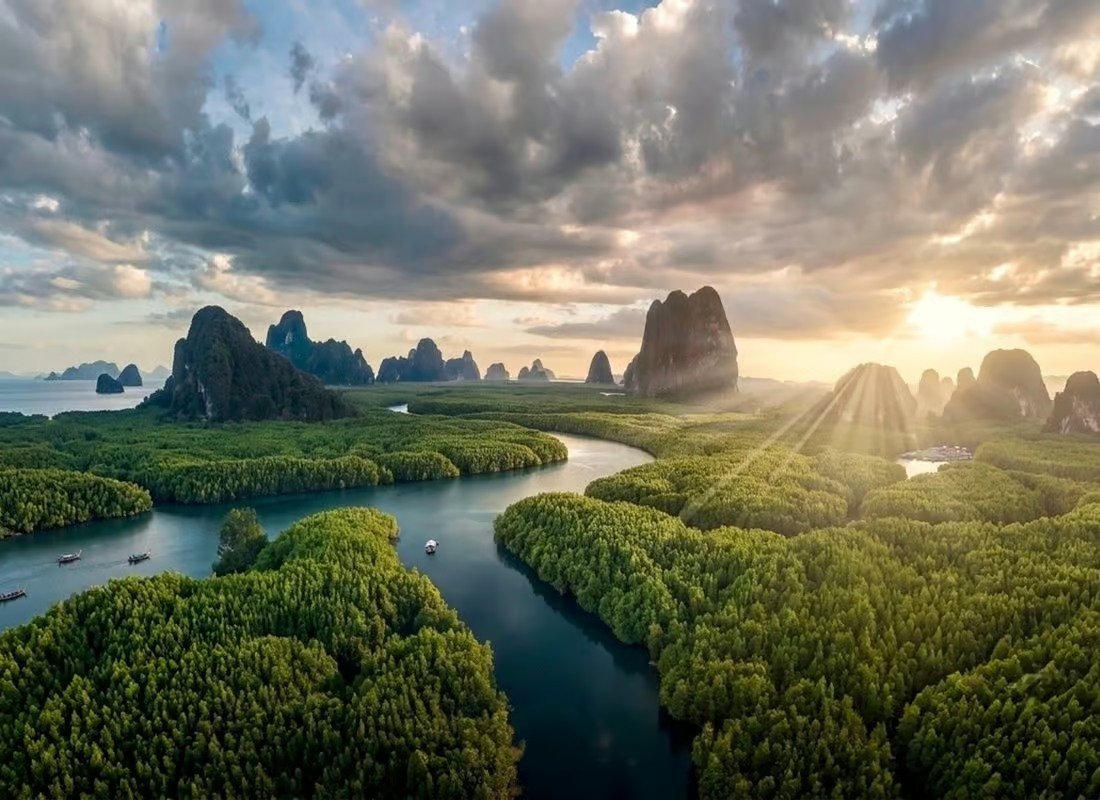
The result is what you see today: the typical karst tower islands – nearly vertical cliff walls crowned with tropical vegetation, while the sea has hollowed out their bases. Inside those hollowed bases hide caves and passages – the doorways to the famous hongs. The karst is not just scenery; it is the reason this bay looks like nowhere else on earth, and the reason the national park protects it.
Timing is everything: at low tide most tunnels are easy to enter, at high tide they can be partially flooded. The tide shifts about 50 minutes later every day, so a good guide plans the kayak stops around the tide table – not around the hotel pickup time. On my tours, we work the itinerary the other way round: we fix the kayaking first, then fit the rest around it.
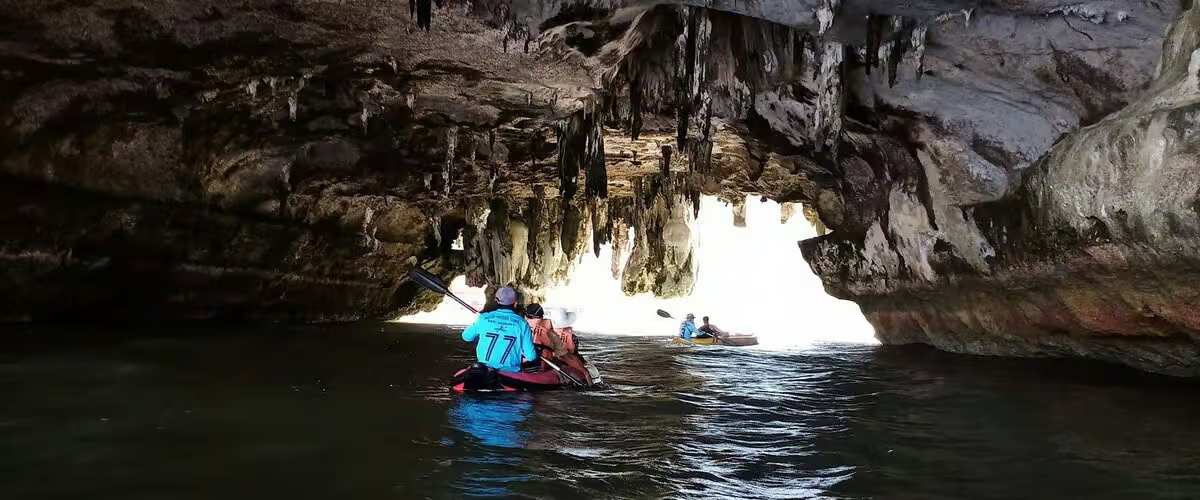
Timing is everything: at low tide most tunnels are easy to enter, at high tide they can be partially flooded. The tide shifts about 50 minutes later every day, so a good guide plans the kayak stops around the tide table – not around the hotel pickup time. On my tours, we work the itinerary the other way round: we fix the kayaking first, then fit the rest around it.
Where exactly do we paddle them? The two islands that matter are Hong Island and Panak Island – I describe both in the best stops section below.
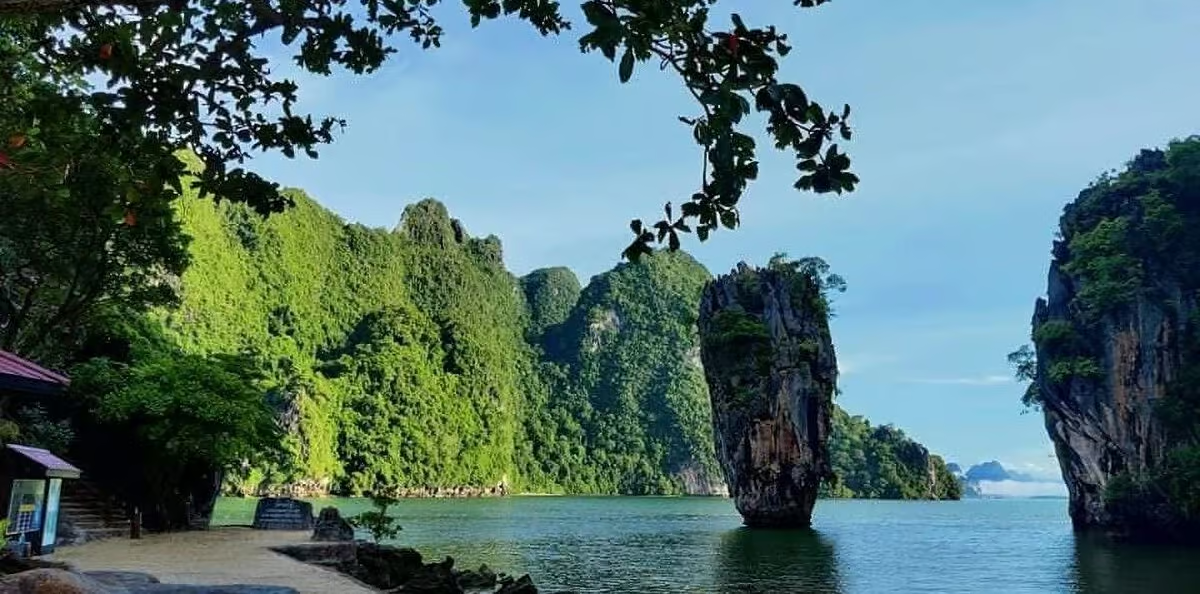
My photographer’s secret: arrive before 9 am. Midday, up to twenty boats share that little beach. For the full story, prices and photo tips, have a look at our detailed James Bond Island tour guide.
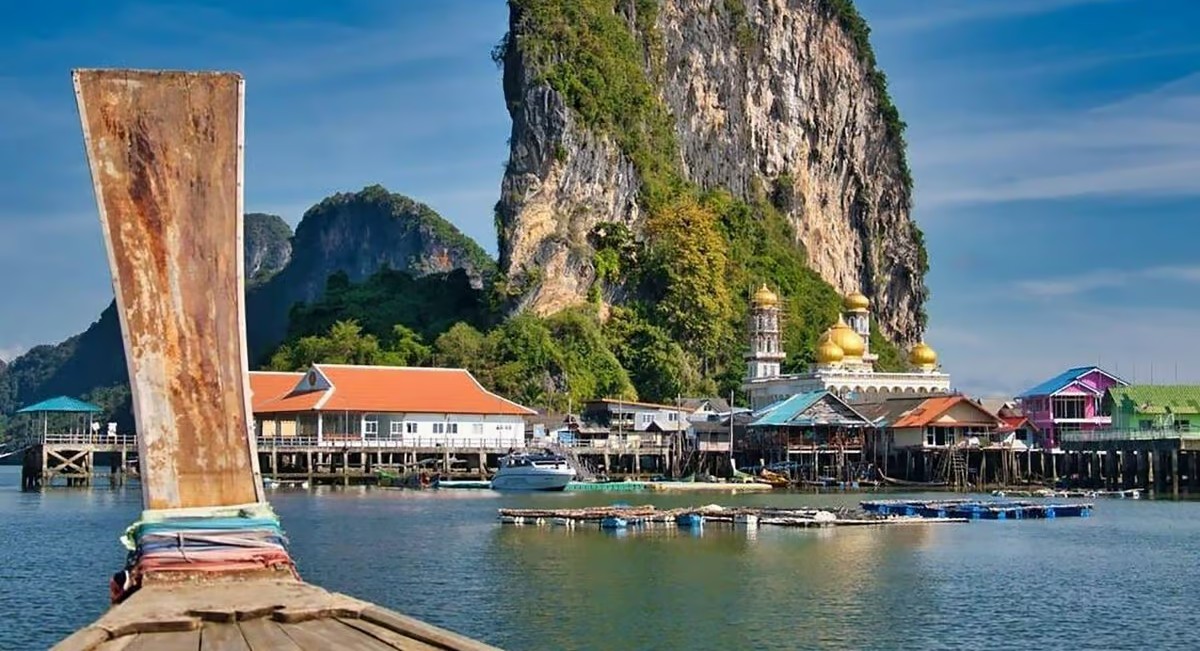
In the middle of the bay, on stilts over the water, sits the Muslim fishing village of Koh Panyee. Around 360 families have lived here for generations – with a mosque, a school, a small market and several seafood restaurants hanging right over the lagoon. The village’s pride is its floating football pitch, where the kids learned to play football on water. In twenty years of bringing guests here, I have never seen a better example of improvisation and community spirit.
Yes, the restaurants are touristy. But the grilled fish with seafood curry and a fresh coconut, eaten with the karst cliffs in front of you, is one of the best lunch experiences in southern Thailand.
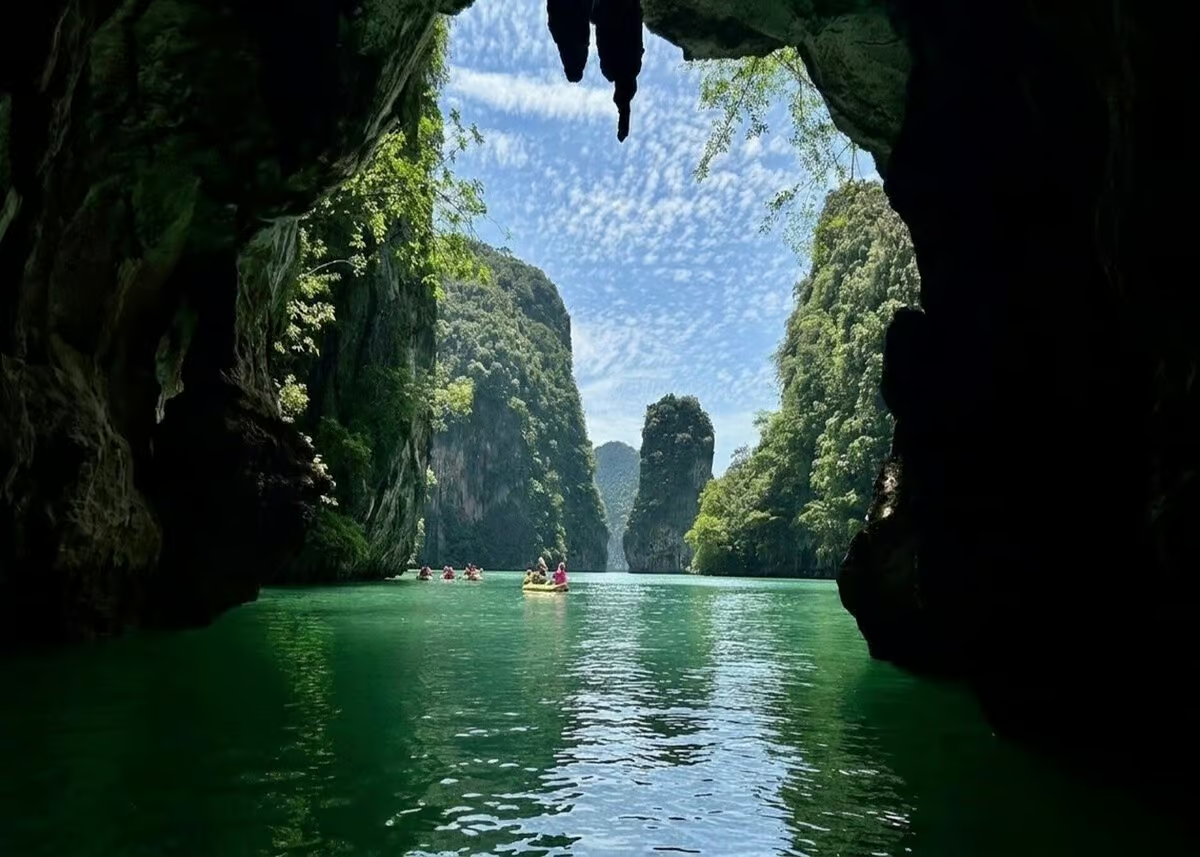
The Hong Islands and the nearby Panak Island are the heart of every kayak tour. Panak is famous for the Ice Cream Cave, whose white rock formations look like dripping vanilla ice cream, and for its hidden lagoons with mangroves growing inside the cliffs. The Hong Islands offer several hongs, each with its own character. Paddle quietly and you are rewarded with silence, birdsong and – if you are lucky – the rare sight of hornbills nesting in the cliff-top trees.
Fair warning: these stops are busy. But after years of guiding I know the quieter corners – which tunnel entrance has no boat waiting at nine in the morning, and which lagoon is empty at low tide.
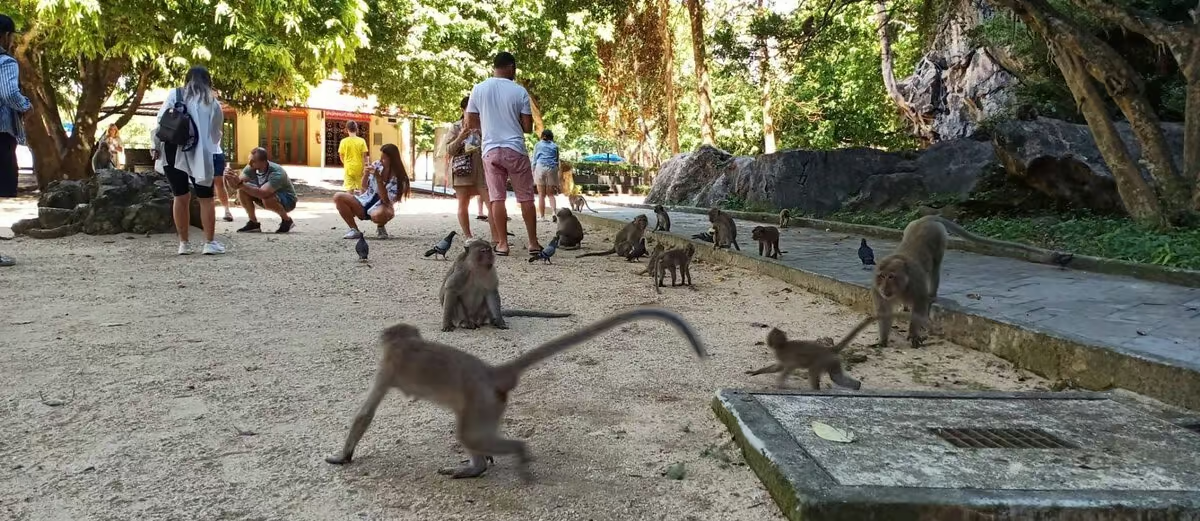
In the shallower water you may spot dugongs (sea cows) – in two decades I have had maybe a dozen sightings, and every one is a moment I still talk about. Water monitors and the rare saltwater crocodile live here too but keep their distance. Over 200 bird species have been recorded: hornbills, kingfishers, herons and storks.
The golden rule for wildlife: be quiet. Kayak groups see dramatically more animals than loud speedboats – that is not theory, we live it on every trip.
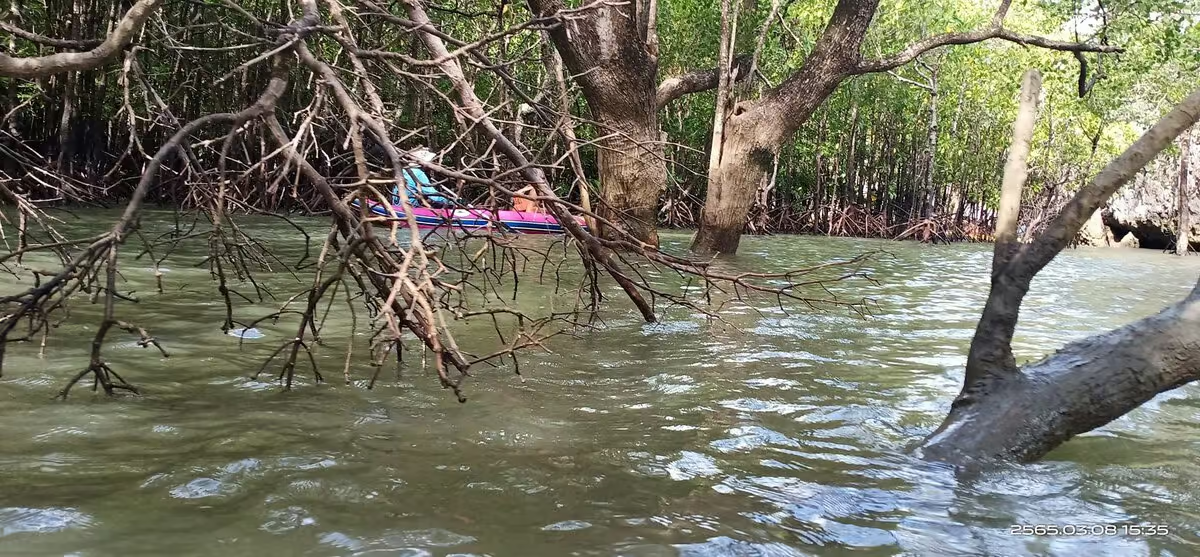
Gliding through the narrow channels you see the root system from below, hear the click of crabs, and finally understand why Thai coastal communities have protected mangroves for generations. It is a quiet, almost meditative experience – and the perfect contrast to the busy morning.
The main departure points are Ao Por Pier on Phuket’s east coast and the Laem Nga Pier in Ratsada, where many longtail tours start. Transfers from your hotel take 30–60 minutes; the boat ride into the bay takes 45–90 minutes depending on the boat type.
| Travel style | Best choice | Why it works |
|---|---|---|
| Families with children | Big boat | More space and shade, calmer on the water, easy full-day trip |
| Limited time | Speedboat | Fast transfer, more stops, direct access to the highlights |
| Comfort & service | Premium speedboat | Smaller groups and a smoother tour flow |
| Couples & nature lovers | Longtail boat | Traditional, slower, closer to the local atmosphere of the bay |
| Photographers | Early-bird or private tour | Better light and fewer people at the viewpoints |
More on the classic option in our longtail boat guide, and on the most comfortable ride in our catamaran tour guide.
The following prices are a practical guide for the most common Phang Nga Bay tours from Phuket. Final prices depend on season, hotel location, operator and availability – always check the booking page before confirming.
| Tour option | Adult price | What’s included |
|---|---|---|
| Longtail boat – sightseeing | from 2,000 THB | Transfer, guide, lunch at Koh Panyee, park fee |
| Longtail boat – with sea canoe | from 2,300 THB | Transfer, guide, canoeing, lunch, park fee |
| Big boat James Bond tour | from 2,800 THB | Transfer, buffet lunch, canoeing, park fee |
| Speedboat James Bond tour | from 2,900 THB | Transfer, lunch, canoeing, more stops, park fee |
| Premium speedboat | approx. 3,600 THB | Smaller groups, better service, park fee |
| James Bond + Khai Island combo | from 3,200 THB | Phang Nga Bay plus snorkelling at Khai Island |
Children (4–11 years) usually pay about 30% less; infants under 3 travel free on most programmes. National park fees (adults ~300 THB, children ~150 THB) are included in most of our packages – but double-check, because some operators charge them separately.
After twenty years in the bay I can honestly say: there is a tour for every taste, from the authentic longtail to the comfortable big boat. All tours include hotel transfer from Phuket, certified guides, insurance and the national park fee.
Prices from ฿2,300 per person. Important: the best kayak tours sell out weeks ahead in high season – book as early as possible, at the latest two to three days before.
Questions before booking? Ask a local Phuket tour advisor on WhatsApp – we answer personally, usually within minutes.
One sentence I give every group: what you see here is not a given – it is the result of more than forty years of protection. Please leave it exactly as you found it.
Easiest is an organised tour from Phuket. Boats leave from Ao Por Pier or Laem Nga Pier; hotel pickup is included. Hotel-to-pier transfer takes 30–60 minutes, the boat ride into the bay 45–90 minutes.
About 2,300 to 4,500 THB per person depending on boat type and programme. Hotel transfer, guide, insurance, park fee and usually lunch are included.
A hong is a hidden lagoon inside a limestone island, reachable only through a sea cave. You paddle in by kayak and enter a silent chamber – most beautiful at low tide.
If you want peace and the hidden hongs: yes, clearly. Kayak tours are slower but reach places speedboats cannot enter. Speedboats are better if you want to cover many stops in one day.
November to April gives you calm seas and little rain. May to October is rainy season – tours still run because the bay is sheltered, and you benefit from fewer crowds and lower prices. For kayak lovers the green rainy season is often even more beautiful.