

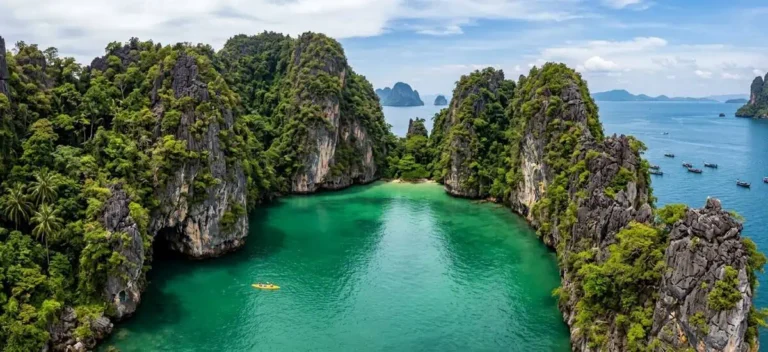
Hong means “room” – the island encloses a lagoon at its centre. This trip suits you if you are looking for scenery and a slower pace, rather than Maya Bay or a lively island town. The viewpoint climb is optional; bring proper shoes rather than flip-flops if you plan to do it.
Depending on the route, Laem Haad and Koh Yao may be added as stops. Laem Haad’s sandbar appears only at low tide, so the itinerary follows the tide. Hong is chiefly about lagoon and limestone; Koh Yao is about villages and island life – a helpful distinction when choosing between the two.
The lagoon is often clear, and tide windows can be busy with boats.
The bay is sheltered and tours often run. Laem Haad always remains tide-dependent.
The roughly 490 steps to the viewpoint are demanding in the heat. If you have knee issues or prefer not to climb, staying at the lagoon is perfectly fine. Do not plan on Laem Haad as a fixed stop: the tide decides.
Laem Haad is a sandbar between Koh Yao Yai and Koh Yao Noi. It can only be walked at low tide; the guide plans the visit around the tide table.
The climb is steep and challenging in the heat, so shoes with grip are important. The view is rewarding, but the lagoon alone is also worth the trip.
Hong is quieter and focuses on lagoons, limestone and mangroves. Maya Bay and the busy parts of Phi Phi Don are not part of this trip.
Snorkeling at outer reefs may be possible if the sea allows. The main reason to choose Hong is the lagoon and scenery, rather than the reef.
Tours start at ฿2,390. Combinations with Koh Yao and more stops cost more and follow a different itinerary.

