The Ton Ao Yon Waterfall is not the kind of waterfall with a ticket booth and a handrail. It is a stream in the jungle behind Cape Panwa, held back by a low concrete weir, with a handful of pools worn into the rock and rock faces you climb with the help of hanging roots. We went on Tuesday, 3 November 2026, with children, and reached it from Ao Yon Beach in five minutes. Twenty baht per vehicle, no toilets, no changing room — and water you actually walk into.
| Location | Cape Panwa, Wichit, Amphoe Mueang Phuket — in the forest above the east coast |
|---|---|
| Address (Google) | R9CQ+XX7, Cape Panwa, Wichit, Mueang Phuket District, Phuket 83000, Thailand |
| Plus code | R9CQ+XX7 |
| Getting there | from Ao Yon Beach (Soi Ao-Yon Khaokhad) about 5 minutes by car |
| Fee | 20 baht per vehicle, once — collected as a cleaning fee, the same for a car or a scooter |
| Parking | dead end at the end of the road, no marked bays, room for a few cars (four were there on our visit) |
| Trail | through the stream, then narrow paths over rock and roots — not a loop, you come back the same way |
| Facilities | no toilets, no showers, no changing room |
| What to bring | water shoes, dry clothes to change into, drinking water |
| Time needed | about 2 hours in our case, with children |
| Supervision | nobody on site, no opening hours, no lifeguard |
| Last checked | Tuesday, 3 November 2026 |
Start at Ao Yon Beach, on Soi Ao-Yon Khaokhad. The drive takes about five minutes by car. Then comes the part that goes wrong: where the main road drops downhill, a narrow lane branches off to the left, on a bend, at an angle — and the sign for the waterfall is easy to look straight past.
That is because it hangs directly underneath the sign of BaanSuan Aoyon Cafe. If you are scanning for “Ton Ao Yon Waterfall” you will notice the café first and the waterfall second. Anyone hunting for the café finds both.
The mangrove forest starts immediately after the turn. On a scooter this is the best stretch of the whole trip: a narrow road, mangroves on both sides, a few palms in between, and every few hundred metres a wooden walkway about three metres long leading off the road into the mangroves. Anyone on a rented scooter gets more out of this than anyone in a car.
Out of the mangroves the road passes a few plantations and small farms. Then, on the right, a group of fairly new white huts appears, with a sign on the fence reading BaanSuan. Next to it hangs a badly faded Ton Ao Yon Waterfall sign. Turn right here.
Past the huts it is another 150 metres or so to the dead end. Forest on every side.
There are no marked parking bays. Whatever space the roadside offers is what you get — four cars were standing there when we arrived, and not many more would fit. Two wheels make parking far less of a question.
On the left stands a small bamboo stall with two attendants. They charge 20 baht per vehicle, once, as a cleaning fee — car or scooter, no difference. After that you step through a metal arch and you are standing at the stream.
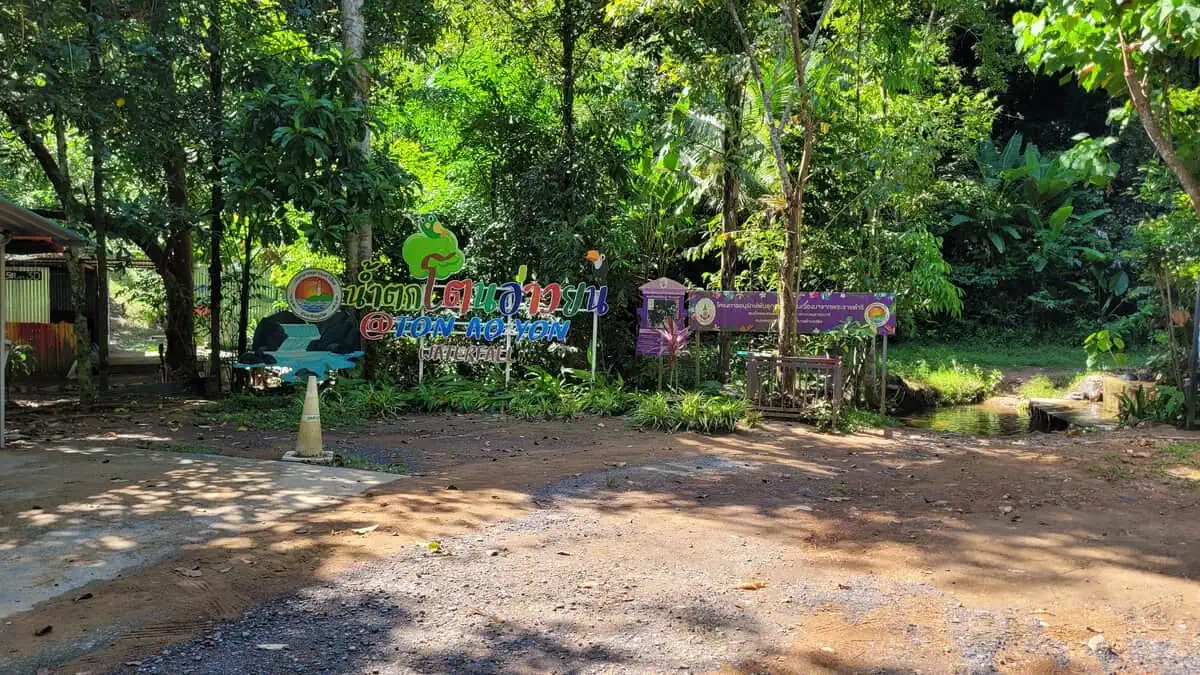
A concrete wall, about 50 centimetres high, runs straight across the stream. Behind it the water backs up to a depth of roughly three metres; in front of it a concrete slab has been laid, and the overflow runs over the top of the wall. This is where the jungle stops being untouched — somebody built something here, and the pool exists because of it.
The slab is slippery. A thin film of algae and mud sits on the concrete and on the stones beside it, and this is the first moment you stand on wet, smooth ground with nothing to hold on to.
And you have to go through the water. The route does not run along the bank — it crosses the stream.
On the far side, narrow paths begin. Nothing has been built here: the Ton Ao Yon Waterfall is a chain of basins, not a single drop. The first pool you reach is a natural one, and a genuinely pretty sight, with the stream running over bare rock in the background and dropping over the edge into the basin. Between the pools the route goes sometimes through water, sometimes through mud.
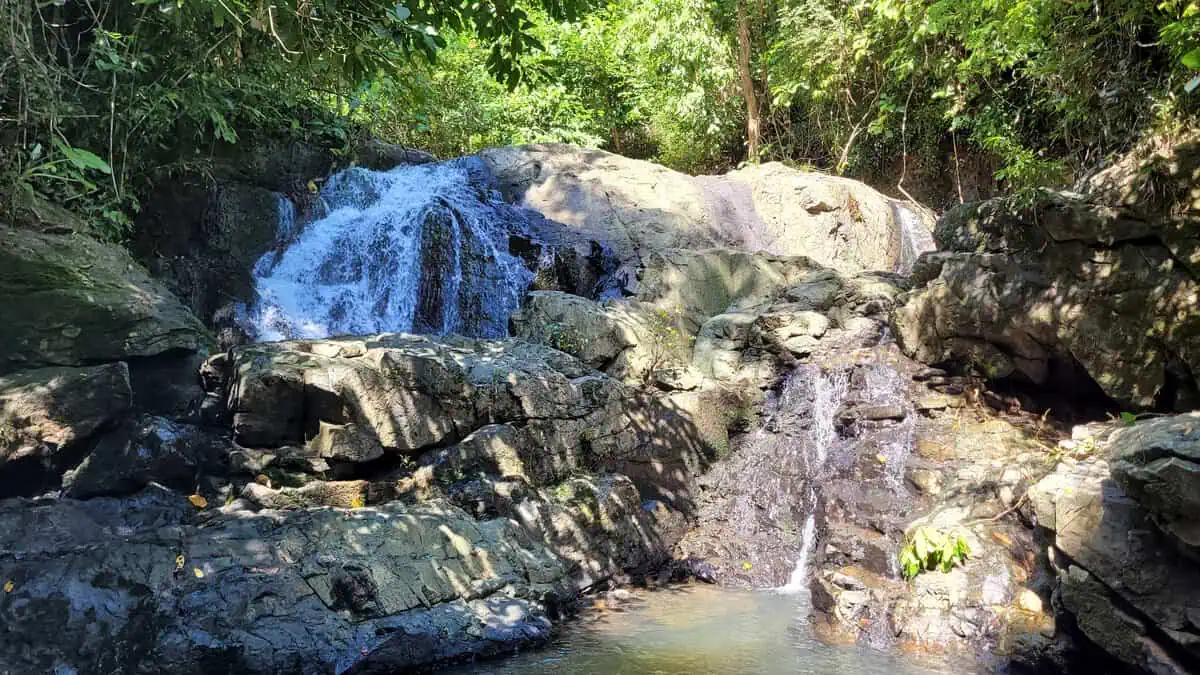
Higher up lies a pool about three metres across and about 1.2 metres deep, framed by thick boulders. From there the route climbs about two metres up a rock face in which the steps are only hinted at; lianas and mangrove roots hang down from above and give you something to hold.
The next pool up is shallower but comes with a slab of rock you can lie on. In the water, among quantities of small stones, lie washed-out shards of coloured glass — between the gravel they look like polished pebbles.
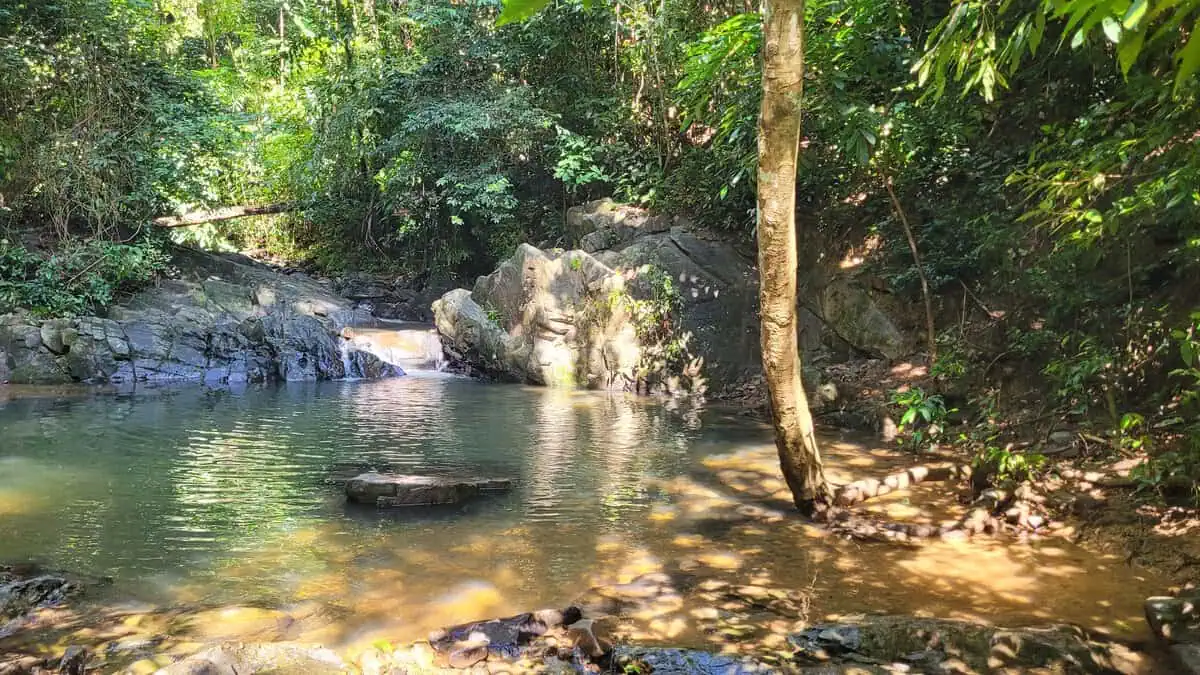
Beyond that the going gets rougher — now over small boulders, now over large ones, always following the water. A last natural basin has less rock and more open surface. Small fish are visible everywhere.
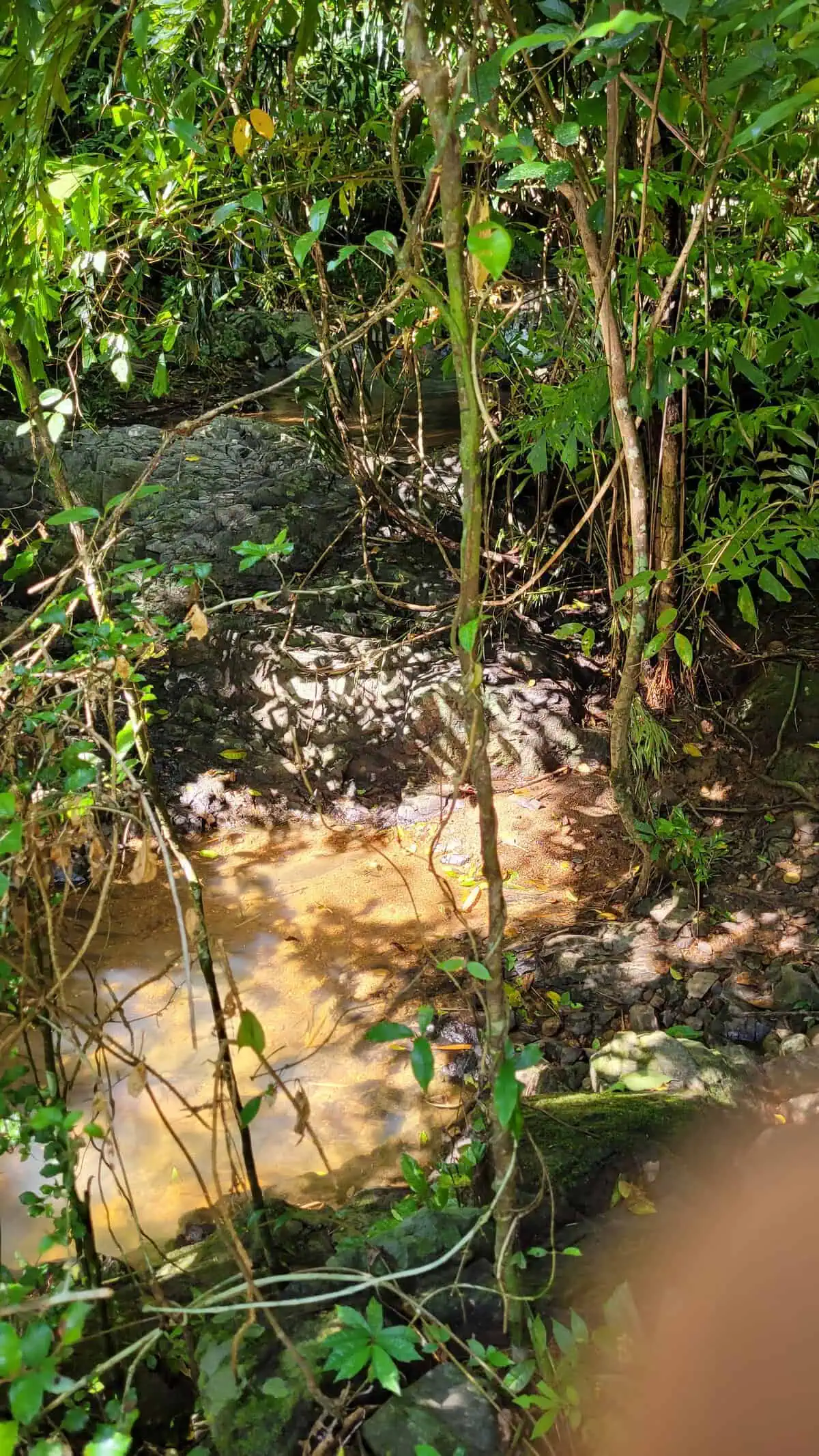
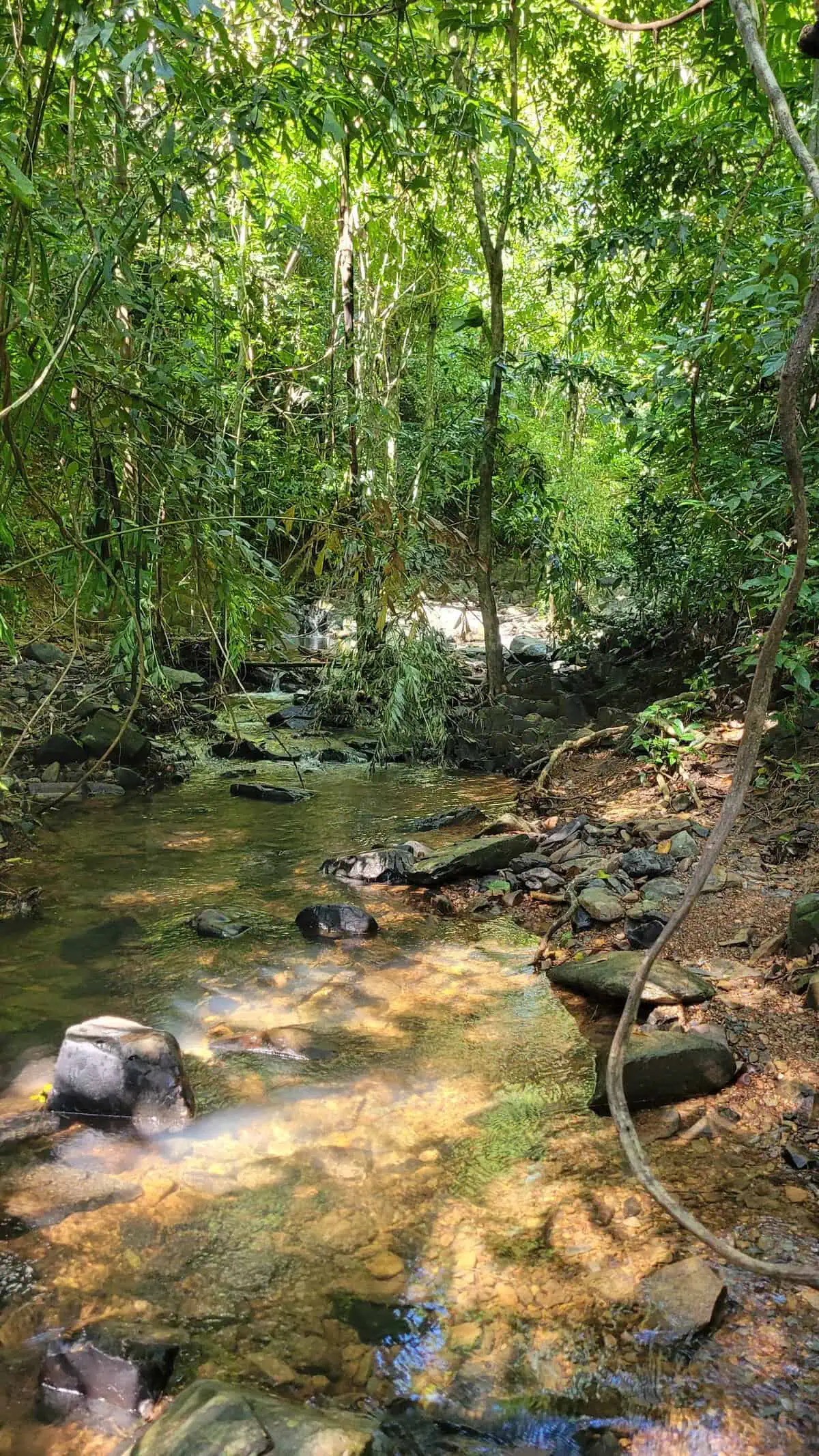
The trip works for children, but only with the right kit. Water shoes are not a recommendation, they are the requirement: the stream bed is full of gravel and glass shards, the rock is smooth, and the crossing is unpaved from start to finish. Trainers are the second mistake — they stay wet for the rest of the day.
Dry clothes belong in the car. There is no toilet, no shower and no changing room, so changing happens at the vehicle. Water and something to eat come with you as well: nothing is sold at the water, only at the bamboo stall down by the car park.
At the two climbing spots the rule is hold hands. The rock face is about two metres high, the steps are barely marked, and the lianas only help if you get a proper grip. For our children this was the best part — not the water, but the way there.
Half a day is more than enough: two hours of swimming and climbing, and the outing has told its whole story.
Yes. Two hours, five minutes of driving and 20 baht per vehicle — that is the whole bill for the Ton Ao Yon Waterfall, and it does not need to be bigger. What makes the place memorable is not the drop of the waterfall but the chain of pools, rock steps and roots you work your way up through.
For the children it was the best part of the day: wading through the stream, scrambling up the rock face, swimming in the upper pool — in that exact order. Anyone expecting a spectacular cascade will be disappointed; anyone after half an hour of jungle without handrails gets precisely this. The natural event — worth the trip.
Local tour guide and licensed tour operator, Phuket — on the island since 1995
Born on 1 January 1984 in Satun, Thailand, and living in Phuket since 1995. Bachelor of Arts in Tourism and Hospitality Management, Phuket Rajabhat University (2005), followed by work at the local tourist information centre. Self-employed tour operator for more than ten years.
Tourism business licence no. 33/11345, issued by Thailand’s Department of Tourism, valid 21 August 2026 to 20 August 2028. Registered business: TIP TOUR INFORMATION PHUKET, 17/59 Moo 1, Kathu, Kathu District, Phuket 83120. Verify the licence yourself — 30-second check on dot.go.th